September Reading Report:
I seem to have drifted back into a slightly higher volume of reading. Maybe it’s because fall landed, it started getting dark earlier, and I haven’t been going outside as much. This is not the right trade for me: I’m happier when I read less, not more. So I need to watch for it.
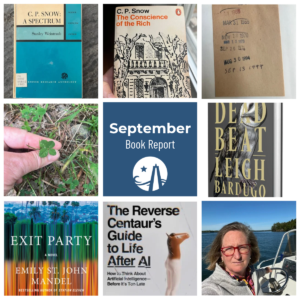 September’s books were a strange combination of dry and spicy. On the spicy side, I finished the latest Leigh Bardugo novel Dead Beat about dark magic at Yale’s secret societies, which I felt compelled to finish despite not thinking it was particularly good. And I enjoyed Cory Doctorow’s opinionated take on the AI bubble: The Reverse Centaur’s Guide to Life After AI. He’s an entertaining writer and I found much of his perspective compelling, even as I’m still not sure what my own foundational beliefs are about the technology and the claims of its interpreters and prognosticators.
On the boring side, I read two works of literary criticism and essays about C.P. Snow. (let’s not pretend you care about the titles of either book — although I’m happy to share if you decide to embark on a clone of my project.)
I think my desire to re-read and think about his work is something of a reaction to two things: the inflection point and uncertainty around technology and how it will be incorporated into the world of this moment. He was thinking about this, as he was grappling with the development of the atomic bomb and the interplay between scientists and policymakers, and how people (men!) of conscience should act. And I think I’m also pulled by the atmospher of the books. There’s something slow and gentlemanly and very analog about the worlds he describes, all tweed and claret and bells ringing in college courtyards as serious people take walks and talk about serious things. It feels nostalgic and aspirational, even while it’s not a world I ever occupied nor that I find a useful model for the world we need. The novel The Conscience of the Rich isn’t boring. But all his books have a reserved quality, and very little plot, so they belong in the dry column.
Still reading Exit Party, but I expect to finish it before the week is out, so I’m counting it in September. It’s excellent (both spicy AND well-written), as I have found all Emily St. John Mandel books.
August Reading Report:
Books completed:
George Passant — by CP Snow
The Light and the Dark — by CP Snow
The Masters — by CP Snow
Our World — Molly Malone Cook & Mary Oliver
To my chagrin, I appear to have lost a library book. It’s not only a moral strike to my character, but I wasn’t finished with it. It was a literary criticism book called “The Novels of CP Snow: A Critical Introduction” published sometime in the 1970s, and to my relief I was able to find it at a used bookshop and have placed an order. Will the library accept it with my apologies?
What’s kind of funny about the lit crit book above is that the author has a lot of faint praise for CP Snow. He’s not much of a plotter, and his descriptions leave a lot to be desired. Nothing much happens. The author doesn’t have much interest in women’s experience. And yet, there’s something to these books. I’m trying to figure out why I like them. (Here’s what a Princeton professor has to say about why he likes them.)
There’s something cumulative about reading all of them — the author braids events together chronologically, skipping major events in certain books that he has a lot to say about in others. He focuses on one friend’s life, while meanwhile he’s building his own career but not saying much about that. In a second book, he talks about building his career and falling in love, while in the background the friend’s struggles are referred to obliquely. It’s a peculiar approach. You kind of have to read all the books to piece together a complete picture of the narrator’s life and relationships.
And it’s a portrait of a society in a time of huge change. The books are largely about work, and the author takes work pretty seriously. The narrator is liberal, but there’s also a lot of respect for bureaucracy and conservative institutions that slow down and temper the voices of individuals. I guess the struggle between individual expression and the work of groups, the compromise and tension that arise when people have to join efforts for common ends, isn’t treated as seriously by any other author I’ve found.
I’ve never read so much about when or whether one should drink claret or port, and I’m going to have to do some research to understand what I’m supposed to conclude about a character whose preference is “wrong” on this topic. I do feel like the author is aware of snobbery without being a snob, and is showing a variety of individual responses to social conventions and expectations without necessarily favoring one particular approach. My grandparents were snobs who loved to mock snobbery in others, and maybe there’s an echo of that sensibility that I feel some affection for.
July Reading Report
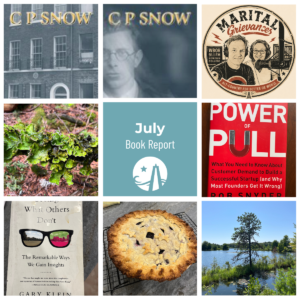
Continuing to read fewer books. I finished only one: CP Snow’s Time of Hope. I’m 75% through George Passant, the next one in the Strangers and Brothers series, and will finish it in the coming days. I’ve read some of the books in the series before, but not in order and not all of them, so I’m going to tackle all 11 in narrative order. I remember liking the narrator and the author’s voice, without remembering why or much about the plots. There is something grounding and generative for me about reading books written 75+ years ago. I’m deeply curious about human nature and quite interested in technology, so I think there’s something to learn from reading about ambitious people whose constraints and options were different than ours. Trying to discern what is essential and unchanging about the human experience and what motivators or stressors are particular circumstances of our time will always interest me.
I also read most of The Power of Pull. Rob Snyder’s way of talking about consumer demand makes a lot of sense to me, and has helped me think about sales in a new way. Like so many business books, there’s a certain amount of filler and case studies to bring it to the publishable size and shape, and I’m finding that the final chapters aren’t adding much to what is a very good core. So I may put this one down as read even if I just skim/flip through the last 25%.
Seeing What Others Don’t is a promising premise by a thinker I respect. Gary Klein wrote a very interesting book about tacit expertise, called Sources of Power, that I liked a lot. But I’m not finding this one super-compelling, so it’s going slowly. Maybe I’ll have more to say about it in August.
Instead of reading, I started a little side project. In addition to the radio show I have with my husband, I started a pop-up summer radio show called What’s Up, Doc? I invite PhDs and MDs to share 5 songs that matter to them: one from youth, one from their graduate study days, one from early career, one from now, and one that represents the future. We talk music and life, and I share some songs theirs make me think of. It’s been fun, and if you want to hear some archived episodes I’d be glad to share the link with you.
June Reading Report
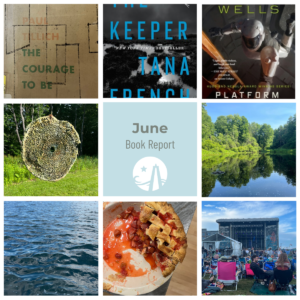
I did it! I read fewer books in June. I went to a concert and an art opening, and a lot of end-of-the-school-year events. I spent as much time as I could on or in water. Even watched some TV.
I read the 8th Murderbot book, which wouldn’t have been good enough to make me want to read the whole series if it had been the first one I read, but was nonetheless one I wanted to gobble up since I’ve come this far.
And I’ll finish Tana French’s latest Cal Hooper novel in the next day or so, which I think means it’s fair game to list in my June tally. She’s always solid.
Is there a word for struggling through, but appreciating, a book? If you know it, pretend I used it to describe the experience of reading Paul Tillich’s The Courage To Be. He was a philosopher and theologian, and the book was published in 1952. It’s about despair and courage. I didn’t bring the background in either philosophy, theology, or political theory that would have made the book easier to understand or evaluate, so it’s hard for me to put Tillich’s ideas into context. And yet I took pages of notes, and will be thinking through those ideas for a long time to come. Worth it. But SLOW going.
May Reading Report
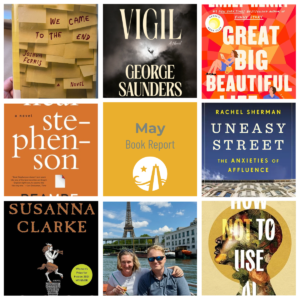
I travelled to Paris in the early part of this month, which meant some time on buses, trains, and planes. That let me indulge in a lot of novels.
Reamde by Neal Stephenson was a reread, and it was just as fun the second time.
I found Pirinesi puzzling and absorbing and the atmospheric scenes will stay with me longer than the semi-satisfying ending. Vigil was atmospheric, but not so absorbing. If you’ve read Lincoln In The Bardo, there are some familiar themes.
Then We Came to The End is a work novel, and I love those. He captured both the affection and irritation we have for our colleagues and bosses, very well. I have a few more Joshua Ferris books to go, and have been impressed enough with him that I’ll keep checking books out of the library until there are no more.
Great Big Beautiful Life is a nice airport snack book. I’ll probably remember the plot for at least another week or two.
Uneasy Street is a sociological study of how wealthy Americans conceptualize whether they “deserve” the money they have, and how they construct and evaluate rules for themselves that govern how to spend it. None of us get to skip a relationship with money, whether we’re interested in and motivated by it or not. Some, but not all, of decisions around work are connected to identity, to money, to what it means to do something meaningful, valuable, useful, or worthwhile. Listening to people with abundant resources struggle with the same questions was interesting. But the book is a bit dense. I’ve attempted it before, but this was the first time I read the whole thing.
How Not To Use AI — I’m still moving through this book and I don’t know what I think about it, or the ideas contained within it. It’s spotty, for sure — some big ideas that stretched my brain, and some pedestrian (and perhaps AI-slop authored?) sections. I try very hard to read non-fiction books on paper, not Kindle, because the ability to page back and forth and see indexes and sections in context would really help with this book, I think. Instead, I’m plodding through it on my Kindle, which isn’t ideal.
April Reading Report
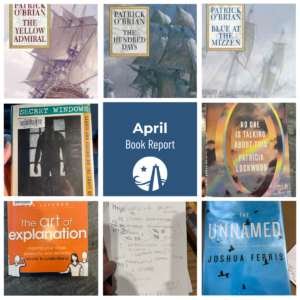
The big news from April is that I have concluded my re-reading of the 20-book Aubrey-Maturin series by Patrick O’Brian. (I’m ignoring the unfinished last volume, which I’ve read before but really is just a scrap of a draft.). I highly recommend these books, and enjoyed the project of re-reading them. AND, I’m glad to be done.
I gobbled up two books by Joshua Ferris. The Unnamed was skillfully written but difficult to read; grim and unsettling. To Rise Again At A Decent Hour was substantive and very funny, and I’ve gone back to the library for more of his work.
I also picked up a book of Stephen King’s essays. I’m very interested in Stephen King as a human and a writer, although I’ve only read a small portion of his work. He’s enormously intelligent and insightful about human nature and about books, two things I’ll never stop being interested in. AND he’s been dismissed by the literary establishment for most of his career. So he has thoughts about ambition and prestige, about whose opinion matters to him and whose does not, about success and fellowship and his place in the world of storytelling. He’s taken his career in interesting directions.
There are people whose minds interest me, even if their fascinations don’t. I find Wesley Morris worth listening to almost always, even when he’s talking about movies I haven’t seen, songs I haven’t heard, or television shows I haven’t watched. (And he usually is — I’m about 20 years behind on most culture, and getting further behind every day.). Stephen King is one of those people.
I was underwhelmed by Patricia Lockwood’s No One Is Talking About This, and returned the other book from her that I got from the library unread.
The Art of Explanation gave me a few ideas to mull on, but you’re probably better off with the Heath Brothers’ Made To Stick if you’re thinking about communicating what’s in your head to an audience.
And I’m in the middle of, and delighted by, Laura Brennan’s Hate Networking Less. My only complaint is that it’s on Kindle, not in a physical book, so I can’t annotate, highlight, and wave it around when I’m talking to clients.
March Reading Report:
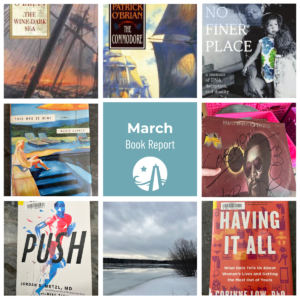
A goal for 2026 is to read fewer books, and remember them better. I’m pleased to say I partly succeeded. I read 6 books in March — fewer! But the remembering part is perhaps a dubious goal.
Push, by Jordan Metzl, MD was instantly forgettable. I picked it up looking for insights about behavior change and motivation, here in the context of exercise habit formation. But it was a meh retread of familiar ideas. Maybe it would hit a new reader differently. I don’t know why I keep doing this.
I read two more Patrick O’Brian novels: The Wine-Dark Sea and The Commodore. I will be finishing this series this month or next, and am already a little regretful. The pleasure I take in reading these books comes partly from the quality of the writing and character development. But some of it comes from the fact that I have forgotten almost everything that happens. I have the vaguest memories of people, ships, and plot points, but there is plenty of novelty and enjoyment that comes from the fact of my forgetting what happened next.
I brought home another delightful re-read: Maria Semple’s This One Is Mine. She’s a terrific writer, insightful and funny, and I grabbed this because I mistakenly thought I hadn’t read it. Luckily, although I began to realize I’d read it before, my lack of recall made the unfolding of events very satisfying. I’ll be going back to revisit her others, which I remember fondly (and vaguely).
A career coach colleague I admire very much has a second life as a writer, and I was interested to read her memoir, No Finer Place. I bought the book because I like to support living writers I know, but was delighted and relieved to discover it was very compelling to read (perhaps a smidge longer than necessary). Family secrets, discovered in adulthood, send her on a journey of history, discovery, and identity that reminds me of my own mother’s memoir.
Having It All by Corinne Low, PhD was the book I’ve been reading slowly, with lots of notes and a running list of articles to read from her bibliography. She’s a Wharton economist, tackling questions of gender, ambition, and choices about life, work, and partnership. I appreciated the data and citations in this book, and think there’s lots to chew on in here. Thanks to my friend and coaching colleague Eleanor Bradley for suggesting Low’s work to me.
I spent a little more time in the WBOR studio this month, chaperoning my teenage son as he learns to be a DJ, and taking on a couple of extra shows with my husband. Substituting listening for reading felt like a pretty good trade.
February Reading Report:
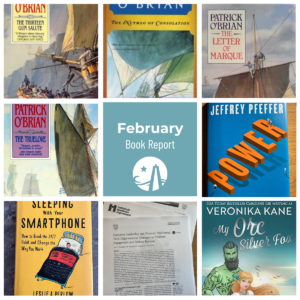
I read four Patrick O’Brian books in February.
- The Thirteen-Gun Salute
- The Far Side of the World
- The Nutmeg of Consolation
- The Truelove
These continue to be delightful. I also succumbed to my Amazon Kindle’s relentless advertising, and downloaded “My Orc Silver Fox,” which the algorithm decided would be a good fit for me. Alas, it was not. I learned that there’s a term for this genre of book: tentacle porn. It’s a cozy romance set in a quaint small town between a woman and an orc, in a sort of alternative universe where such things exist. I don’t know why Amazon was so convinced that I would like it, but it’s not my thing. Good try, algorithm.
Power by Jeffrey Pfeffer — I first read this slightly distasteful book by Stanford professor Jeffrey Pfeffer about fifteen years ago. His main argument is that merit and power are different skillsets, and if you want to accomplish important things, you need to study and work at acquiring power. The methods include flattery, alliances, and attention to influencing others. It’s not a particularly compelling book (he wrote a 1992 book called Managing With Power that’s much better in my opinion) but the ideas inside are worth considering. What do you want to achieve, and what are you willing to do to gain the influence and power you will need to achieve it?
Sleeping with Your Smartphone by Leslie Perlow — Harvard Business School Professor writing a book-length case study about BCG Consulting’s work to give its teams predictable time off, while still delivering intense and client-focused professional services. I’m curious what the follow up has been; promising practices when published in 2012 — but not yet widely adopted across professional services staffing models.
A few articles about burnout, including one from the Mayo Clinic that I found fascinating.
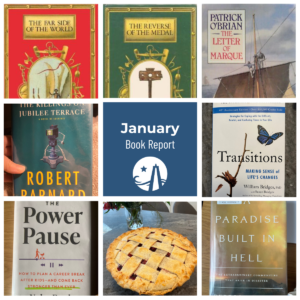
January report: It’s been very cold here in Maine, which usually means more time by the fire reading. But I’ve spent a lot more time anxiously scrolling than usual. Reading helps.
I made it through 3 more Patrick O’Brian Books:
- The Far Side of the World
- The Reverse of the Medal
- The Letter of Marque
They’re delightful, but I got tired and I wanted a change of pace. I found a mystery in the neighbor’s Little Free Library: The Killings on Jubilee Terrace. Can’t recommend it, unfortunately. But it was enough perspective for me to appreciate O’Brian’s excellent writing, deep character development, and plotting. So I’m happily reading Book 13 in the series. At this rate I should be done by spring.
But you don’t come here to hear about fiction. My nonfiction books this month are below:
The Power Pause — Neha Ruch. This is a book explicitly aimed at a certain kind of mother (ambitious, probably upper-middle class) around the decision to step away from work to focus on children. It’s a decision I hear women thinking and talking about, and the book does a decent job moving through the things that can contribute to ambivalence, identity questions, and self-doubt. I know smart women who have found it very helpful. My own assessment is that it’s fine, nothing special. I’ve written before about how hard it is for me to evaluate some resources, because they repeat so many of ideas that I’ve previously encountered in other books, studies, and frameworks. That doesn’t mean it’s not helpful to the right reader, someone contemplating these things for the first time. It’s not a bad entry point into some of the self-examination that a certain kind of woman might need in conjunction with a particular life transition. But it didn’t push my thinking in any new direction.
I’ll add that I recognize gender as a defining social force, identity marker, and bucket for some people. I know there are norms and pressures that show up differently. But I personally haven’t found “moms” to be a valuable organizing category. “Parents” is a little better, but still not descriptive enough for me to determine whether I’ll have something interesting in common with someone else. It’s like having legs, for me. My legs are a fundamental part of my life, but the fact that you have legs and so do I doesn’t open the door to conversations that interest me much. So a career book specifically for mothers probably will never get my highest rating, even as it might be exactly the thing for some folks.
Transitions — William Bridges. This book is famous enough, and I’ve read enough ABOUT it, that I didn’t realize my bookmark was stuck halfway through it. So it was good to finish this. Last year I took a coaching certification program called Navigating Transitions that heavily referenced Bridges. Because of that, I didn’t read this with beginner eyes. The big takeaway of this book is that circumstances that look quite different (divorce, job loss, becoming a parent, getting a cancer diagnosis, getting a big promotion) share characteristics and follow some patterns. The old thing ends…. there’s an interval of loss, confusion, uncertainty as we try to figure out who we are without the old thing….. and eventually the new situation starts to feel normal, and we have more confidence and direction. That’s an INTERNAL process, that doesn’t necessarily take place on the same timeline as what is visible to the outside world. I use the ideas from this book and from the course all the time as I work with people through big transitions.
A Paradise Built in Hell — Rebecca Solnit. I’m only halfway through this book, but it’s having a big impact on me. The author’s interest is in the altruism, cooperation, and even joy that arises in communities immediately after a natural disaster, when the traditional civic institutions and structures governing ordinary life are absent or powerless. She examines a number of disasters through history, looking not only at what happened but at the underlying beliefs about human nature that brought about certain behaviors and reactions. It’s fascinating. Her belief is that we want to be connected, we yearn for ways to look after one another, and when disasters remove the social estrangement that many people feel in everyday life, it is felt as a kind of gift by the communities who survive disaster. Good writer, good thinker; I’m going to be turning her thesis over in my head for a good long time. This is a library book that I will probably buy, because I’d like to annotate, underline, and revisit it.