It’s been very cold here in Maine, which usually means more time by the fire reading. But I’ve spent a lot more time anxiously scrolling than usual. Reading helps.
I made it through 3 more Patrick O’Brian Books:
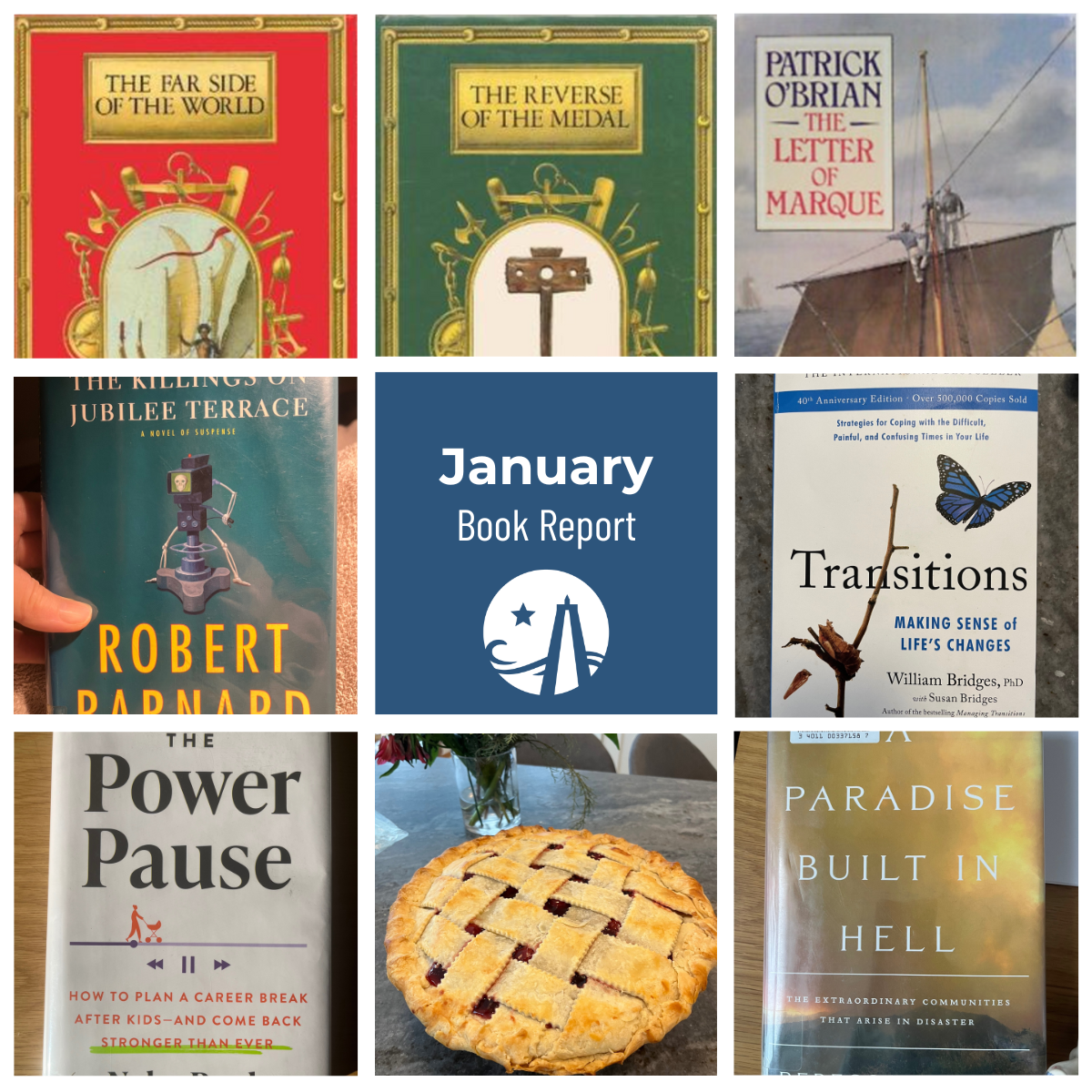
- The Far Side of the World
- The Reverse of the Medal
- The Letter of Marque
They’re delightful, but I got tired and I wanted a change of pace. I found a mystery in the neighbor’s Little Free Library: The Killings on Jubilee Terrace. Can’t recommend it, unfortunately. But it was enough perspective for me to appreciate O’Brian’s excellent writing, deep character development, and plotting. So I’m happily reading Book 13 in the series. At this rate I should be done by spring.
But you don’t come here to hear about fiction. My nonfiction books this month are below:
The Power Pause — Neha Ruch. This is a book explicitly aimed at a certain kind of mother (ambitious, probably upper-middle class) around the decision to step away from work to focus on children. It’s a decision I hear women thinking and talking about, and the book does a decent job moving through the things that can contribute to ambivalence, identity questions, and self-doubt. I know smart women who have found it very helpful. My own assessment is that it’s fine, nothing special. I’ve written before about how hard it is for me to evaluate some resources, because they repeat so many of ideas that I’ve previously encountered in other books, studies, and frameworks. That doesn’t mean it’s not helpful to the right reader, someone contemplating these things for the first time. It’s not a bad entry point into some of the self-examination that a certain kind of woman might need in conjunction with a particular life transition. But it didn’t push my thinking in any new direction.
I’ll add that I recognize gender as a defining social force, identity marker, and bucket for some people. I know there are norms and pressures that show up differently. But I personally haven’t found “moms” to be a useful organizing category. “Parents” is a little better, but still not descriptive enough for me to determine whether I’ll have something interesting in common with someone else. So a career book specifically for mothers probably will never get my highest rating, even as it might be exactly the thing for some folks.
Transitions — William Bridges. This book is famous enough, and I’ve read enough ABOUT it, that I didn’t realize my bookmark was stuck halfway through it. So it was good to finish this. Last year I took a coaching certification program called Navigating Transitions that heavily referenced Bridges. Because of that, I didn’t read this with beginner eyes. The big takeaway of this book is that circumstances that look quite different (divorce, job loss, becoming a parent, getting a cancer diagnosis, getting a big promotion) share characteristics and follow some patterns. The old thing ends…. there’s an interval of loss, confusion, uncertainty as we try to figure out who we are without the old thing….. and eventually the new situation starts to feel normal, and we have more confidence and direction. That’s an INTERNAL process, that doesn’t necessarily take place on the same timeline as what is visible to the outside world. I use the ideas from this book and from the course all the time as I work with people through big transitions.
A Paradise Built in Hell — Rebecca Solnit. I’m only halfway through this book, but it’s having a big impact on me. The author’s interest is in the altruism, cooperation, and even joy that arises in communities immediately after a natural disaster, when the traditional civic institutions and structures governing ordinary life are absent or powerless. She examines a number of disasters through history, looking not only at what happened but at the underlying beliefs about human nature that brought about certain behaviors and reactions. It’s fascinating. Her belief is that we want to be connected, we yearn for ways to look after one another, and when disasters remove the social estrangement that many people feel in everyday life, it is felt as a kind of gift by the communities who survive disaster. Good writer, good thinker; I’m going to be turning her thesis over in my head for a good long time. This is a library book that I will probably buy, because I’d like to annotate, underline, and revisit it.