You’re looking for your next right thing: the work arrangement that balances challenge and growth with your desire to pursue things besides work.
The sweet spot between languishing / bored, and overwhelmed / anxious. People you enjoy, who bring out your best, and who value what you offer. The right tradeoff between time and money. A sense of meaning, identity,and purpose that motivates you on hard days.
You need three things to get there:
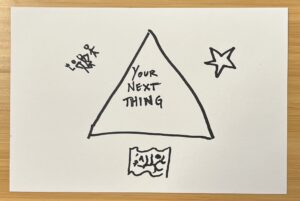
- Your north star — What does good look like? We need a sharp, clear definition to work toward.
- The trail map — What are the plausible paths to attaining that good life? We’ll need to compare them to decide which is the best.
- Your support crew — Whose help will you need to reach your goal? Success doesn’t happen alone.
I think this is pretty straightforward. What gets in the way?
The enemy of your north star is vague aspirations. Clients say things like this to me:
- “It’s easy to think of what I don’t want. But figuring out what I do want? I need a lot of help with that.”
- “Should, should, should. I’ve always let other people’s opinions influence my decision. I don’t know if I ever took the time to think about what I wanted.”
- “I’ve been head down in spreadsheets. What do I want next, where do I want to go? I’ve been too busy to think about it.”
- “I can dream-talk myself into anything….or out of anything.”
- “I guess I don’t really know myself.”
When I work with clients, we conquer this vagueness with two concrete exercises — and when those steps are complete, we generate a Mission Brief. This is a document, built from our conversations, that describes your superpowers, the problems you love solving, the attributes of the kinds of environments that bring out your best, and the red flags to avoid.
It’s not unusual for clients to cry when they read this.
- “Nobody has ever given me a synthesis across my jobs like that.“
- “The moment it all clicked for me was with the documents…. that was when I was like, oh yeah, this is the project. This is the thing I never would have unlocked if I were just talking to people and sitting by myself.“
- “Anytime you read something about yourself that feels true it’s kind of an emotional thing, and I realized that these are kind of all words that I said…It’s just so different to see it filled out…because it’s so easy to bury your own strengths.”
The obstacle to a clear trail map is circular thinking. It’s getting paralyzed by the risk of taking action, or wondering whether you’re even qualified for something you want, or worrying so much about an unknown that you hesitate to take the first step.
Sometimes that risk aversion looks like staying with the familiar long after it feels good, because the downsides of every alternative are clear to you and the benefits are more speculative.
Sometimes it’s undiscerning action — applying randomly without purpose or conviction, hoping maybe someone else will make the decision for you. Or pursuing lots of possibilities briefly, then giving up when you don’t make the kind of clear progress you’re used to in the world you know best.
- “The overwhelm comes you jump to the end and haven’t done the work. Of course it feels impossible to choose — you looked up six opportunities on LinkedIn and you’re like, I don’t know, maybe I could do this, would I like it, I don’t know.”
- “Fear of choosing. Every time I say yes to one thing, I have to say no to another.”
- “I’ve been in this state for a while. I don’t know how to fill the skill gaps. I don’t know what I’m doing, and then I spiral. And I just jump right back on that hamster wheel.”
We defeat overthinking and analysis paralysis with design thinking — first we flare, to generate ideas, and then we focus, to evaluate and select a handful of the best for further research. When this step is complete, we develop a Quest Map: the possibilities worth investigating, and the questions and challenges to focus on to build confidence in the choice you’ll make.
One client described the Quest Map as “helping me tell a build a different story about myself — and to make it usable. Not just insightful, but actionable.”
What gets in the way of activating the support of others is the belief that this needs to be a lonely slog. The feeling that you’re not ready yet to talk to others, or that the exploration you are undertaking is shameful or risky to your reputation.
And of course there are risks. On the one hand is the risk of wasting time, yours and others, on empty, fruitless, or vague coffees and lunches that go nowhere. Not knowing how to talk about yourself or your work, and making a negative impression. On the other hand is the risk that if you reveal you’re considering a change, your contacts will deliver opportunities before you have the chance to evaluate them, or advice that doesn’t apply to you — and then you’ll be stuck making a decision before you’re ready or having an awkward conversation.
- “Shame is a barrier to motivation. It’s hard to set goals, because I’m ashamed of not knowing more. It’s connected to identity.”
- “Sometimes I wonder if I got lucky, and if that was all the luck I’m going to have. What if I can’t tell my story, if I can’t transfer what I’m good at to a different arena?”
Other people can facilitate or hinder your access to opportunities. We conquer fear of reaching out by getting crystal clear about the four ways people in your network can help you, and building a specific outreach plan. It focuses on who’s in your network, exactly what kinds of help you need, and how you’ll frame each of your conversations to increase the probability of success. You’ll also build your karma, confidence, and authentic relationships by focusing on how you can help others, not solely seek favors. This stage of coaching concludes with an Outreach Plan, that will guide you through creating and strengthening the relationships that will make your journey into the next chapter smoother, faster, and more fun.
I’ve re-designed my coaching practice around the three sides of this triangle, with a repeatable, clear process for achieving each element needed for success, and a deliverable document marking the completion of each step.
If you need this and want to get started, book a discovery call, or email sherry@daymarkcareers.com and I’ll send you info on this program.