The most important shift you can make if you are a smart person thinking about your next opportunity is recognizing that most approaches to job hunting are extremely limited. They focus solely on one method of landing a role. And it’s the method where there is the most competition and the least possibility to create something interesting.
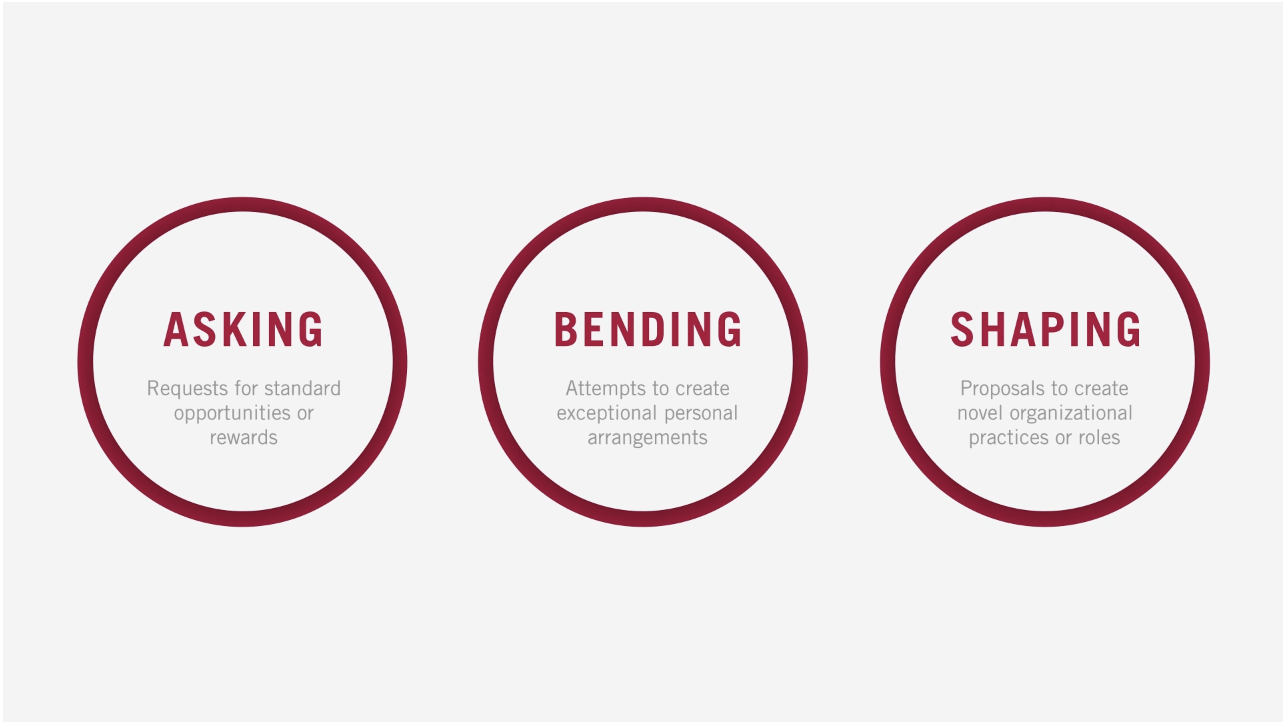
Harvard Kennedy School’s Hannah Riley Bowles has developed some wonderful approaches to negotiation. The most significant is her articulation of the 3 kinds of negotiation:
Asking. Bending. and Shaping.
In less than 4 minutes, she walks you through these 3 distinct kinds of opportunities — and how a smart negotiator can position herself most strongly in each. Watch the video here.
In the context of job hunting, Asking negotiations are what we all know and think about. An employer posts a job description. Everyone assumes that is an accurate and complete depiction of what they need and want. Applicants compete to present themselves as meeting the requirements depicted in the job description.
But if you have eyes to see and ears to hear, you’ll recognize that sometimes, the person who is chosen doesn’t meet the stated job description exactly. The fact that this happens so often is because there are also Bending negotiations. The most successful candidate in this scenario recognizes the possibility that the stated requirements are negotiable. Their approach is to push the organization to consider different factors than what was originally stated. This works because job descriptions are rarely crafted carefully and accurately. These days, many of them are re-posted or drafted by AI. What an organization really needs or wants, and the value they place on different skills, traits, and knowledge is almost never accurately and explicitly stated. In this ambiguity, high performers can find opportunity!
And the least known of all, but the most juicy for accomplished people, are Shaping negotiations. These are opportunities created by people who can articulate a problem AND simultaneously position themselves as the solution to that problem. Consultants and freelancers can do this, sure. But so can people within an organization. Where is there a need? How might you approach it? Whether this is a role change, the creation of a new project or initiative, or a completely new title and set of responsibilities, Shaping negotiations take place all the time.
When you recognize this framework, you’ll begin seeing it all the time. And this can help you find and win opportunities that others don’t even see.