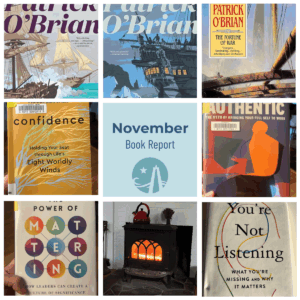
 I probably won’t pick up any new fiction for a few months, because I’m happily absorbed in rereading the Patrick O’Brien Aubrey/Maturin novels. There are 20, and I’m currently on Book 7. In November, I finished The Mauritius Command, Desolation Island, and The Fortune of War. These books feel like comfort food for me: familiar characters, exciting plots, a distant and detailed world that’s wildly different from my own. But the writing is much better than many fictional escapes, so it doesn’t come with sheepish guilt.
Confidence: Holding Your Seat Through Life’s Eight Worldly Winds by Ethan Nichtern This was an impulse pick, off my library’s “New Nonfiction” shelf, and I was unexpectedly delighted by it. I’m not a Buddhist, but many people who are in my Good People Personal Hall of Fame are, so I hold the practices and reflections in high regard. This book talks about some ways of walking the tightrope of these universal four tensions: Pleasure and Pain; Praise and Criticism; Influence and Insignificance; and Success and Failure. I can relate to the struggle to keep a clear head when faced with these aversions and temptations. He says the answers are in 4 Buddhist practices: compassion, lineage, awareness, and “windhorse.” The lineage and windhorse concepts are ones I’ll be thinking more about, both personally and in my work with clients.
You’re Not Listening by Kate Murphy. Why do I keep reading books like this? The title is all you need, but somehow she got a book contract to write chapter after chapter about different aspects of listening and why it’s important. She’s a good writer (she’s been a journalist), and as always I mined the endnotes for some scholarship I’d like to read more of. But if you know being a good listener matters, you can skip the book. And if you don’t know it matters, I’m not sure reading the book will do much to change your mind.
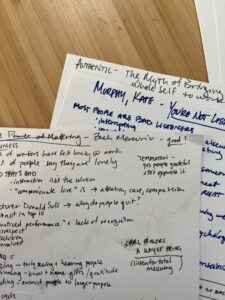
The Power of Mattering by Zach Mercurio. On the other hand, this book covers much of the same ground (human connection is important and hard, and most people are bad at it). The author is positioning himself on the thought leadership circuit, so he’s explicitly connecting these deficits to work settings and identifying himself as a man with the formula and expertise to correct them. But he’s done a skillful job with the science, and he’s included some actionable frameworks. I made a surprised exclamation “good!” on my notecard for this book.
Authentic: The Myth of Bringing Your Whole Self To Work by Jodi-Ann Burey — an interesting combination of memoir, journalism, and social commentary highlighting the implicit racism and ableism in the buzzwords and discourse around “authenticity.”
Interestingly, 3 of these books referenced someone named Carl Rogers, a groundbreaking psychologist whose name hadn’t penetrated my awareness yet. Maybe I should be embarrassed about that. Anyway, I’ll be trying to read more of his work directly now. I like it when multiple sources start pointing me to a topic or an author or a thinker. It feels like a sign.